You’ve got overgrown land. Palmetto scrub, Brazilian pepper, wax myrtle, maybe some small pines that crept in over the years. You start researching your options — and you keep seeing the term forestry mulching. But what is it, exactly? Is it right for your property?
This guide covers everything you need to know: how the process works, when it makes sense, what it costs in Hernando County, and how it compares to traditional land clearing. By the end, you’ll know whether to make the call.
→ Ready to clear your land ?Get a Free Forestry Mulching Estimate
What Is Forestry Mulching?
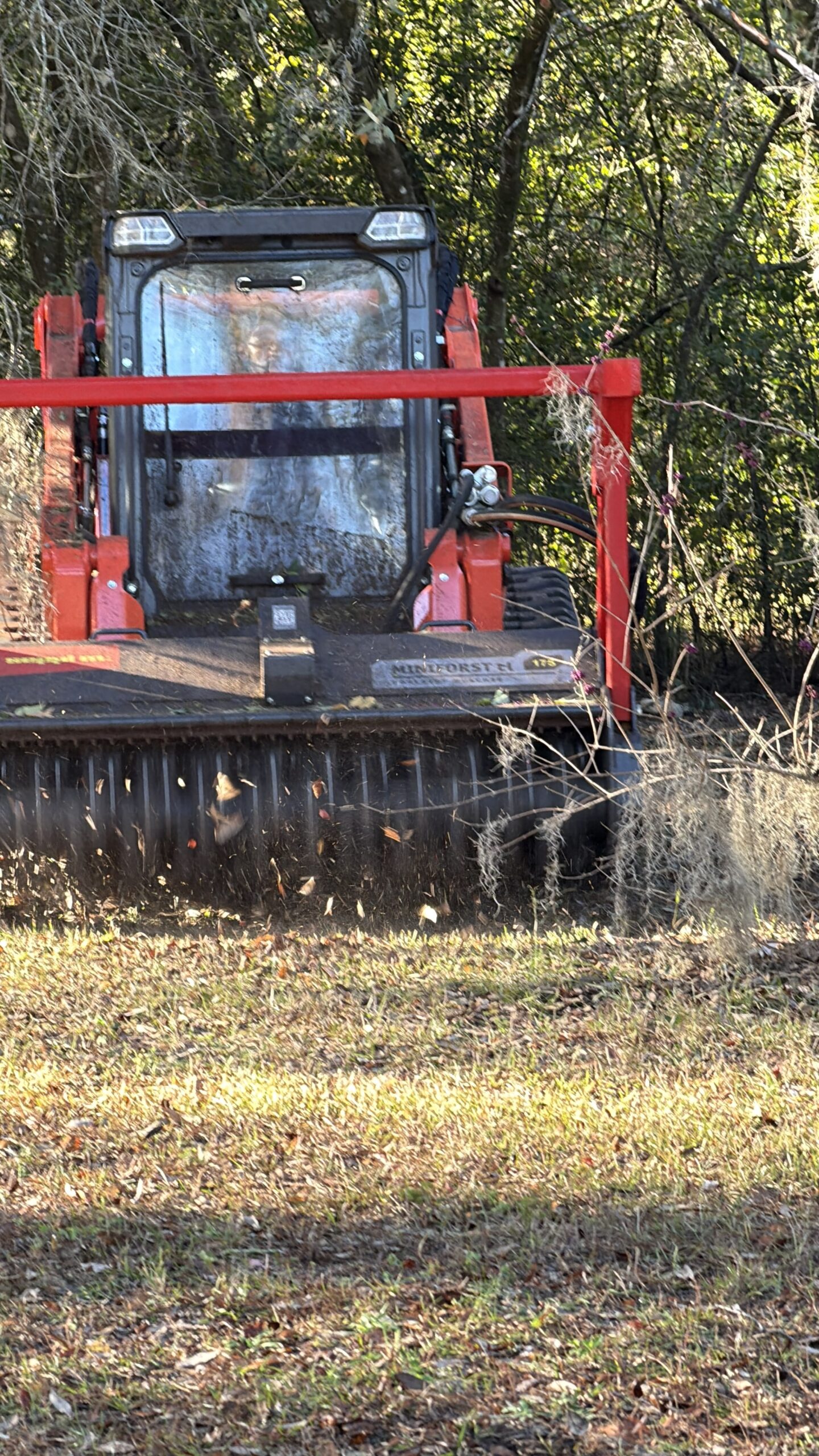
Forestry mulching is a single-pass land clearing method that uses one specialized machine to grind trees, brush, stumps, and vegetation into a fine layer of mulch — which is left on the ground in place.
Unlike traditional land clearing, where debris gets pushed into piles, hauled off, or burned, forestry mulching converts everything on-site into natural ground cover. One machine. One pass. No debris piles. No burn permits. No haul-off fees.
That mulch layer does real work for your soil: it protects against erosion, retains moisture through Florida’s dry seasons, and breaks down over time to return nutrients to the ground.
How the Process Works
The Equipment
A forestry mulcher is a tracked machine with a high-speed rotating drum covered in carbide-tipped steel teeth. When those teeth contact vegetation, they shred it into chips almost instantly. For typical Florida residential and agricultural lots, the machine works in deliberate passes — methodically covering the property from one end to the other.
What Gets Mulched
Virtually everything above ground: brush, vines, palmetto, small and medium trees, stumps, and invasive vegetation. In Hernando County, that typically means:
- Saw palmetto — one of the most common vegetation types across the county
- Brazilian pepper (invasive) — mulching is one of the most thorough mechanical removal methods available. The Florida Fish & Wildlife Conservation Commission identifies it as the most widespread invasive plant in Florida, occupying more than 700,000 acres statewide
- Wax myrtle, gallberry, and native shrubs
- Pine trees and live oak saplings up to 6–10 inches in diameter
- Vines and creeping groundcover
What to Expect on Job Day
- Site walkthrough — the operator confirms boundaries, notes any buried utilities or septic locations, and reviews the plan with you before the machine leaves the trailer.
- Systematic clearing — the machine works in passes across the property; any trees you want preserved are marked and worked around.
- Final walkthrough — the cleared property is reviewed together before the machine is loaded out.
⚠️ What Forestry Mulching Cannot Do: It is not designed for finish grading, removal of very large hardwood stumps, or producing a completely bare lot as required by some construction permits. If your project needs any of those, you may need traditional clearing or a combination of both methods. JBS will advise you honestly during your free estimate.
Forestry Mulching vs. Traditional Land Clearing
Neither method is universally better — the right choice depends on what you plan to do with the land afterward.
| Factor | Forestry Mulching | Traditional Land Clearing |
| Debris handling | Mulched in place, stays on-site | Piled, hauled, or burned |
| Soil disturbance | Minimal — surface contact only | Significant — topsoil often disturbed |
| Erosion risk after clearing | Low — mulch protects soil | Higher — bare soil exposed |
| Best suited for | Pasture reclaim, overgrown lots, trails, habitat management | Construction site prep, large-timber removal |
| General cost | Often lower — no haul-off cost | Higher when debris removal is included |
If you’re reclaiming a pasture, opening an overgrown residential lot, or managing invasive vegetation without immediate construction plans, forestry mulching is almost always the better fit. If you’re preparing for a building permit or need a completely bare lot, traditional clearing or a hybrid approach may be more appropriate.
Why Forestry Mulching Works Especially Well in Florida
Sandy Soil Protection
Florida’s sandy soils erode quickly when exposed. The mulch layer left by forestry mulching acts as ground armor — protecting soil structure while the land settles or is re-seeded, which is especially important heading into the rainy season.
Invasive Vegetation
Brazilian pepper, cogon grass, and similar invasives are endemic problems across Hernando, Citrus, and Marion Counties. According to UF/IFAS Extension, mechanical removal that disrupts plant structure is most effective as a first-strike method, typically followed with targeted herbicide application to suppress regrowth from surviving root material.
Pasture Reclamation
A Florida pasture that hasn’t been actively managed in five to ten years can become completely overtaken by palmetto and volunteer trees. Forestry mulching reclaims that land far faster than manual clearing, and the resulting mulch layer enriches the soil as it breaks down — making it ready to re-seed.
Wetland Adjacency
Because forestry mulching disturbs far less soil than traditional clearing methods, it is often the preferred — and sometimes required — approach near wetland buffers or drainage setbacks. Before any clearing near a wetland, verify requirements with Hernando County’s Planning & Zoning Division and the Southwest Florida Water Management District (SWFWMD).
What Does Forestry Mulching Cost in Hernando County?
Forestry mulching is typically priced per acre, per hour, or as a flat job rate depending on scope. Key factors that affect your price:
- Acreage — larger properties typically carry a lower per-acre rate
- Vegetation density — palmetto-heavy land takes significantly more time than open brush
- Tree size — larger trees require more machine passes and more cutting effort
- Lot access — tight entry points, soft ground, or wet ground conditions can affect pricing
For a typical 1-acre residential lot in Hernando County with moderate palmetto and brush, expect a range of roughly $1,200–$3,500. Agricultural and multi-acre projects are quoted on a per-acre basis at a lower rate.
The only accurate price is one based on actually seeing your property. JBS offers free on-site estimates — we walk the land, assess the vegetation, and give you a clear number before any commitment is made.
→ Call (352) 610-6853 or schedule your free estimate online
Is Forestry Mulching Right for Your Property?
Forestry Mulching Is Likely the Right Choice If…
- You have an overgrown residential lot, pasture, or acreage with brush and palmetto
- You are not breaking ground for construction immediately
- You want reclaimed land without bare-soil erosion risk
- You need to manage or remove invasive vegetation
- You want trails, sight lines, or property access opened up
- You prefer a single-machine, low-disturbance clearing process
Consider Traditional Clearing or a Combination If…
- You are preparing the site for a home, commercial building, or paved surface
- Your county or lender requires a bare lot for construction permits
- You have very large hardwood trees that exceed mulcher capacity
- You need finish grading or complete removal of organic material from the surface
Not sure which applies to your situation? That is exactly what the free estimate is for. We would rather walk your property and give you an honest recommendation than sell you a service that is not the right fit.
The Bottom Line
Forestry mulching is one of the most efficient, soil-friendly, and cost-effective ways to clear overgrown land in Central Florida. It handles the vegetation types that define Florida properties — palmetto, invasives, scrub oak, volunteer pines — and leaves the land in better condition than bare-soil clearing methods.
Whether you’re reclaiming a pasture in Brooksville, opening a residential lot in Spring Hill, or managing overgrown acreage in Citrus or Marion County, JBS Land Management has the equipment and the local experience to get it done right.
→ Get your free estimate today | Call (352) 610-6853
Frequently Asked Questions
Have more questions? Visit our full FAQ page.
How long does forestry mulching take?
For a typical 1-acre residential lot in Hernando County with moderate palmetto and brush, expect 4–8 hours of machine time. Denser vegetation or larger acreage takes proportionally longer. Your on-site estimate will include a projected timeline.
Does forestry mulching kill the vegetation permanently?
Forestry mulching thoroughly destroys above-ground vegetation and significantly disrupts root systems. However, vigorous species like Brazilian pepper, cogon grass, and saw palmetto can re-sprout from surviving root material. UF/IFAS research recommends combining mechanical removal with targeted herbicide follow-up for the most persistent invasive species.
Will the mulch attract termites?
Ground-contact mulch near a home’s foundation does carry some termite risk. For properties being mulched within 10–15 feet of a structure, consult your pest control provider beforehand. For open land well away from structures, the risk is minimal and the soil benefits generally outweigh the concern.
Can forestry mulching be done near wetlands?
Forestry mulching is often preferred near wetlands precisely because it minimizes soil disturbance compared to traditional clearing. That said, Florida wetlands carry strict buffer requirements. Always verify setback distances with Hernando County’s Planning & Zoning Division and the Southwest Florida Water Management District before any clearing near a wetland area.
Do I need a permit for forestry mulching in Hernando County?
It depends on what’s on your property. For standard residential clearing, no standalone clearing permit is required for typical brush and small trees. However, per Hernando County’s official zoning guidelines, a tree removal permit is required before removing any specimen tree (18″ DBH or larger) or majestic tree (36″ DBH or larger). If your property is near a wetland setback or within an environmentally sensitive zone, additional permits may apply. When in doubt, contact Hernando County’s Planning & Zoning Division at 352-754-4057 before any work begins.
How soon can I use my land after forestry mulching?
Immediately. The land is accessible and walkable the same day the machine finishes. There are no debris piles to remove, no haul trucks to wait on, and no burn period. Your cleared property is ready to walk, fence, or seed the moment the job wraps up.